You know the feeling.
That thing that happens before things even properly start. The moment you realise - it's already too late.
And you lie there afterward, staring at the ceiling, while she goes quiet beside you. Not angry. Just... quiet. And somehow that silence is ten times worse than anything she could actually say out loud.
Maybe she's used to it now.
Maybe she's stopped expecting anything different from me.
You have tried things. Quietly. Desperately. At 1am when she's asleep and you're scrolling through your phone, typing searches you delete immediately afterward because what if someone sees your history?
You have spent money. On sprays. On herbs. On things you bought while pretending to browse something else in the pharmacy. On YouTube tutorials that told you to "think about football" during sex - as if that is a real solution for a grown man.
None of it worked. Not really. Not permanently.
And now? Now you've started avoiding the bedroom. Work stress, you tell her. Tiredness. A headache. You've become creative with your excuses because the truth is too heavy to carry out loud.
How do you tell your wife that you are afraid of your own bedroom?
You can't tell your friends. What would they say? You can't tell your doctor - the appointment alone requires more courage than you have for this particular secret. You can't tell your brother, your pastor, your imam. Nobody.
So you carry it. Alone. Every single day.
It lives behind your eyes when she reaches for your hand in bed. It lives in your chest when she mentions a friend's husband - how attentive he is, how present. You smile and nod and think to yourself: if only she knew.
You are a man who provides. A man who shows up. A man who handles things. But this one thing - this one private thing - has made you feel like a fraud in your own marriage for longer than you want to admit.
I know exactly how that feels.
Because I lived it for six years.
Drop everything you are doing now and listen to every word I'm about to say.
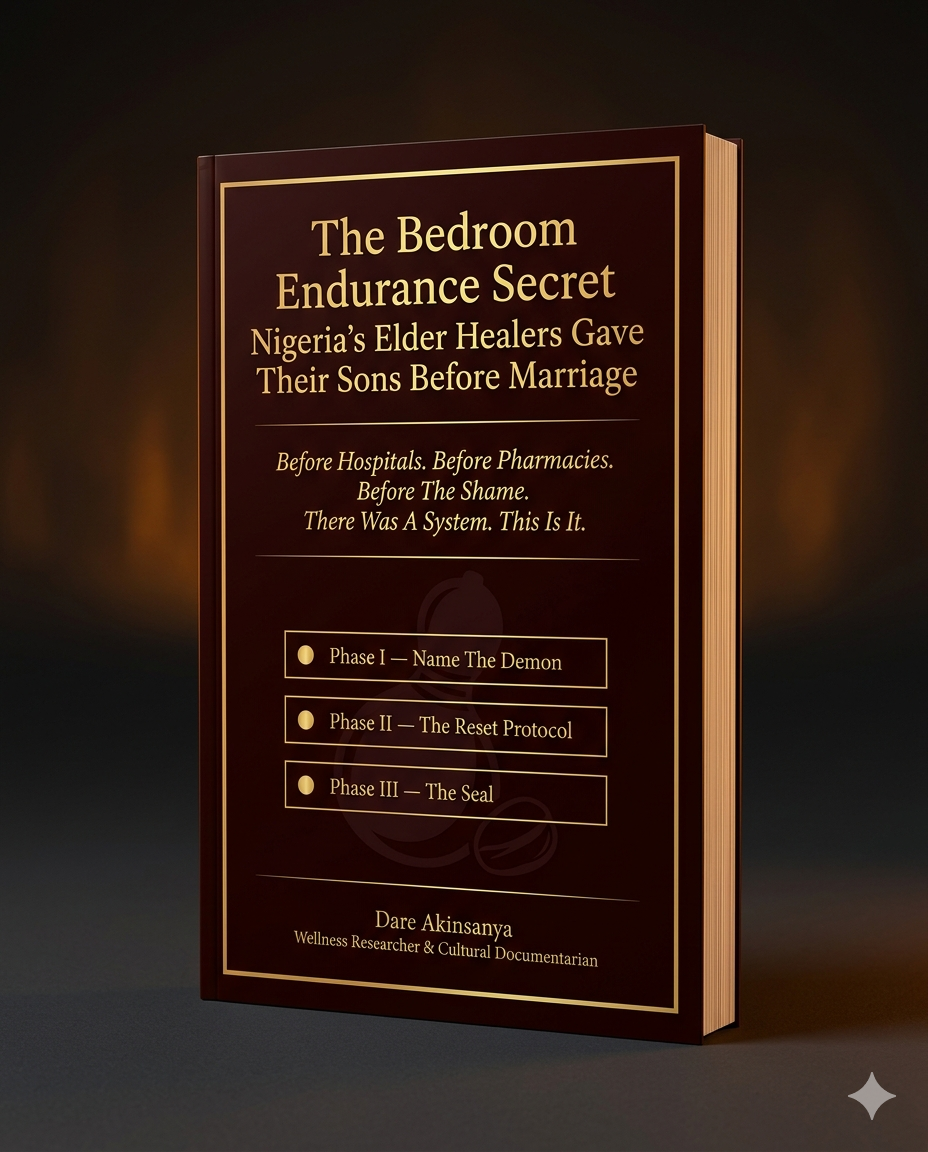
Because I'm about to share with you a simple 7-day system that changed everything for me — and has already changed everything for dozens of men who have quietly used it since.
Let Me Tell You Everything - From The Beginning
My wife and I got married in 2019. We were happy. Genuinely happy. We had the wedding in Lagos, the honeymoon in Accra, the whole beautiful beginning. I was confident going into that marriage. I had built a business. I knew how to handle pressure. I thought I knew how to handle everything.
I did not know about this.
The first time it happened - really happened, badly - was about three months into the marriage. I told myself it was the stress of the new business. The adjustment to living together. Normal things. I said it so convincingly to myself that I almost believed it.
But it kept happening.
By the end of the first year, a pattern had set in that I did not know how to break. Two minutes. Sometimes less. The anticipation of it happening made it happen faster. The shame of it happening made the next time worse. And the time after that, worse still. It was a cycle that fed itself, and I had no idea how to step out of it.
What It Was Doing To My Marriage
My wife - God bless her, never once raised her voice at me about it. Never once shamed me directly. But I could feel the distance growing. Small things. The way she stopped initiating. The way she turned away a little faster afterward. The way conversations about intimacy became vague and brief.
I started making excuses to avoid the bedroom altogether. Work stress - real, because I genuinely was stressed. Tiredness - also real. But underneath all of it was a man who had become afraid of his own wife's body because every encounter felt like a test he was guaranteed to fail.
"Dare, are you okay? We barely even... I mean. Are you okay?"
She asked me that one night - gently, carefully - and I said I was fine. I was not fine. It was the loneliest I have ever felt inside a marriage that was supposed to make me feel less alone. I lay there that night thinking about what kind of man cannot even satisfy his own wife. What kind of husband. What that means about who I am.
That was my breaking point.
Everything I Tried That Did Not Work
After that night, I started searching. Quietly. Carefully. Always making sure to delete the history, always buying things in places where nobody would recognise me.
✕ Delay sprays from the pharmacy
I bought the first one while pretending to browse blood pressure medication. It reduced sensation so completely that intimacy felt mechanical and hollow. My wife actually asked me one night if something was wrong - she could tell something felt different. I stopped after three weeks. The problem remained.
✕ Agbo mixture from a roadside seller in Surulere
The man told me three days and my life would change. It gave me a temporary boost for maybe four days, then stomach discomfort, then nothing. I went back. He sold me a stronger batch. Same result. I spent over ₦15,000 in total and walked away with nothing except a suspicious wife who could smell the bitterness on my breath each morning.
✕ "Last longer" desensitising condoms
Same principle as the sprays — they killed sensation to the point where I felt nothing and therefore what was the point? Intimacy became something I endured rather than something I shared. My wife stopped reaching for my hand during. I noticed. I said nothing.
✕ YouTube breathing and distraction techniques
I spent three weeks trying the "think about something else" method. Concentrate on your breathing. Count backward from 100. Focus on a spot on the wall. All of which meant I was completely absent from the experience - not present with my wife, not enjoying anything, just managing a countdown in my head. Some nights it helped marginally. Most nights it changed nothing. And it is not a way to live.
✕ Alcohol before intimacy
This one felt like it was working for a few weeks. Until it didn't. And then I had created a new anxiety: what if I haven't had enough tonight? What if one drink isn't sufficient? It is not a solution - it is a substitution of one problem for another. I stopped when I realised I was thinking about when to have my first drink every evening by mid-afternoon.
✕ Deciding to simply accept it and hope things improved
I tried this for almost an entire year. Six years of marriage, and two of them were spent telling myself: "This is just who you are now. Make peace with it." The peace never came. The shame grew. The distance between my wife and me grew with it.
The Burial in Ibadan
My uncle passed in the summer of 2024. The burial was in Ibadan - three days of ceremony, extended family, food, prayers, and the particular kind of emotional weight that comes with marking the end of a life. I drove down with my wife and we stayed with relatives.
On the third day, in the evening, the older men had gathered under the canopy at the far end of the compound, away from the noise of the younger crowd, the music, the children running between legs. I sat slightly apart from them. I was quiet in the way I had become quiet, not peaceful, just withdrawn. Somewhere far inside myself.
An old man looked across at me from where he was sitting. Small in stature. Unhurried in the way he moved. He smelled faintly of efinrin and cloves. He gave me a slow nod - the kind that carries something in it - and gestured for me to come and sit beside him. Something in that gesture made me go.
He did not introduce himself immediately. He simply asked how I was doing and why I sat far away. Without hesitation, I answered quitely "Nothing really Sir". And after a comfortable silence, without looking at me directly, he said::
"You drove from Lagos?"
I said yes. He nodded. We watched the compound together in silence for a while - the children weaving between adults, the women arranging food across long tables, the generator humming steadily at the far fence. Then he asked how long I had been married. I told him six years. He asked if I had children. Two, I said.
"Good man," he said quietly. And then, after another pause, he turned slightly toward me and asked: "Marriage is a long road. How is yours going?"
There was something in the way he asked. Not intrusive. Not nosy. Just genuinely open - like a door left ajar rather than pushed. And I don't fully know why, even now, but I answered him more honestly than I had answered anyone in years.
I told him things were fine. Then I told him they were mostly fine. Then - and I still cannot explain what loosened in me under that canopy that evening - I told him that my marriage was carrying a weight I did not know how to put down. I did not say everything directly. I said enough. I talked around it the way Nigerian men talk around things that are too large to name out loud. I spoke about distance. About feeling like I was failing my wife somewhere I couldn't point to on a map. About a silence between us that had been quietly growing for years and that I did not know how to close.
He listened without interrupting once. Without shifting in his seat. Without offering the quick reassurances people usually rush in with to end uncomfortable conversations.
When I finished, he was quiet for a long moment. Then he asked me one question, delivered so gently it did not feel like an intrusion at all:
"This distance you are describing. Is it coming from inside the bedroom?"
I did not answer. But I did not deny it either. I looked away toward the compound. And that silence was its own answer.
He nodded slowly - not with surprise, not with judgement, but with the particular recognition of a man who has sat beside this exact conversation many times before across many decades.
"This thing you are carrying - it is not new. It is not yours alone. And it is not permanent. Our fathers had a name for it, and they had a solution for it too. Long before there were pharmacies."
— Pa Ifatunde Adeleke, Traditional Wellness Practitioner, Oyo State
I did not respond. I did not know what to say. He continued - speaking slowly, without pressure:
"Our fathers prepared their sons for marriage completely. Not just with money and prayers. With knowledge. Knowledge that has been forgotten because the hospitals came and told us our old ways were primitive. But the hospitals cannot fix what the old ways understood."
His name was Pa Ifatunde Adeleke. 81 years old. A retired traditional wellness practitioner from Oyo State who had spent over fifty years working with men in his community on what he called - very simply, "the private troubles men carry but never speak."
He had never seen the inside of a pharmacy. He had never needed to.
What Pa Adeleke Told Me That Evening
We spoke for nearly an hour under that canopy. He asked me nothing directly - he simply spoke, as if he already knew everything and was giving me permission to recognise myself in what he was saying. Then he asked me to come and see him before I left Ibadan. I went.
Sitting in his small compound in the late afternoon, drinking kunu, he told me something that no spray seller, no YouTube doctor, no agbo man had ever said to me in six years of searching:
"What you are experiencing is not a disease. It is not a curse. It is not who you are as a man. It is something your body was taught. By fear. By shame. By years of experiences that told your nervous system: finish fast, it is safer. Your body learned the wrong lesson. And what the body has learned, the body can unlearn. Completely. If you give it the right instruction, in the right sequence, for seven days."
Seven days, I thought. I've been dealing with this for six years and he's telling me seven days.
I did not fully believe him. I want to be honest about that. I had been disappointed too many times to believe anything easily. But something in the way he spoke, without urgency, without salesmanship, without any desperation to convince me - made me sit still and keep listening.
Before I left, he gave me a piece of paper. And asked me to write down seven practices - one for each day - built from decades of traditional wellness knowledge gathered from elder healers. He told me to follow the sequence exactly. He told me not to skip days. He told me to trust the process.
I folded that paper and put it in my wallet.
It stayed there until I had memorised every word on it.
The First Few Days - Honest Account
I will not lie to you: Days 1 and 2 felt like nothing. I read what Pa Adeleke told me about understanding the root of the problem - the anxiety loop, the way shame trains the nervous system, the way the body protects itself by finishing fast as a kind of escape response. It made intellectual sense. But I felt no different.
Here we go again, I thought on Day 3. Another thing that isn't going to work.
But I kept going. Because the old man had told me not to skip days. And something stubborn in me — the same stubbornness that had built my business from nothing - refused to quit before the end.
Day 3, I started the things he had described. It felt strange. Almost too simple to be real.
Days 4 and 5, I followed the breathing work and the physical sequence exactly as Pa Adeleke had written it. No pharmacy. No market. No herb seller. Just the practices. Specific. Sequenced. Private.
Day 5. Something shifted.
I cannot describe it to you precisely. But there was a moment during that evening's intimacy where I realised - I had been present. Not monitoring. Not counting. Not managing a countdown in my head. Just... present. And it had lasted. Not forever. But longer. Noticeably longer. And I had done it without a spray, without a drink, without thinking about football.
Day 7 - I was a different man in that bedroom.
The Night My Wife Noticed
I had not said anything to her. There was nothing to explain yet - I was waiting to be sure. But on the eighth night, she turned to me afterward and was quiet for a moment. A different silence. Softer. Warmer. And then she said:
"Dare. What happened to you? Where did you go and come back from?"
She was smiling. I had not seen that particular smile in a very long time. I did not explain everything. I told her I had found something that helped. She held my hand in the dark and said - "Whatever it is, don't stop."
I have not stopped since.
Others At That Burial Were Listening Too
What I didn't know that evening under the canopy was that two other men had been sitting close enough to hear parts of what Pa Adeleke shared. One of them - Emeka, a 41-year-old from Port Harcourt, married 7 years - came to me a week later through a mutual contact. He had recognised himself in the conversation. He had gone and seen Pa Adeleke himself.
He sent me a voice note three weeks after. I will never forget what he said: "Dare. Brother. Where has this thing been? My wife is looking at me like we are newly married. I don't know how to thank you."
Another man - Tunde, 36, from Abuja - had a different experience. He was more sceptical than I was. He tried the method for two days, convinced it was too simple to work, and almost quit. His wife's words on Day 9 are what made him message me: "She told me she felt like she had her husband back. That one sentence made me cry. I'm not ashamed to say it."
A third - I will call him K., because he asked me not to use his name - lives in London now. He had been dealing with this problem for nearly a decade, navigating Nigerian marriage expectations while living in a Western environment where the shame felt even more isolated. He tried the method and on Day 8 sent me a single line: "It works. Just tell others."
So that is what I am doing.


💬 Share Your Experience